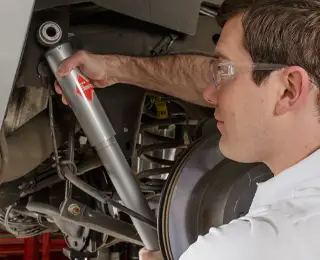
Shock and Strut Inspection and Replacement FAQ
The Basics on Shocks & Struts
When shocks and struts are doing their job, they can help give your vehicle a smoother, safer ride. That includes better braking efficiency, as well as less wear and tear on other parts of your car or truck, including the brake pads and tires. Below are some of the more commonly asked questions about these important parts. If you don’t find the answers you were looking for, come to your local Les Schwab.

What are shocks and struts, and what do they do?
The shocks (also known as shock absorbers) and struts on your vehicle help your tires maintain constant contact with the road. That’s an important job. To do that, the shocks and struts work together to help prevent excessive bouncing, while the struts do an extra job of supporting the overall vehicle. When you hit a pothole, go over a bump, step on the brakes, or turn a corner, your shocks and struts go to work.
Learn more about the shock and strut services available at Les Schwab.
How do shocks and struts support vehicle performance?
Along with the right tires, shocks and struts are key factors in ride control. Ride control is how well your car handles when encountering bumps, road debris, sudden stops, swerving, potholes, wind gusts, and sharp turns. Vehicle control can be reduced when shocks and struts aren’t properly controlling the side-to-side, front-to-back, and up-and-down shifts of the car’s weight that come with everyday driving. This is an even larger concern when the road is slippery, wet, or rough.
Whether you’re towing a camper, off-road driving, or spending hours a day behind the wheel of a commercial vehicle, you might consider upgrading your shocks and struts to meet your overall needs. Schedule an appointment at Les Schwab.
How long do shocks and struts last?
Depending on where, what, and how you drive, the shocks and struts on your vehicle could last anywhere from 80,000 to 100,000 miles. However, those parts often deteriorate slowly. That means you might not notice the gradual decline in ride quality, braking, and overall control. At Les Schwab, we’ve been inspecting and replacing shocks and struts for decades. Come by for an honest evaluation of their current condition.
How do I know what type of shock is right for my vehicle?
Every vehicle uses a specific type of shock absorber, whether you drive a minivan, SUV, or something built for off-road adventures. Below are the six main types of shocks and the types of vehicles where you’ll typically find them.
- Commuters and Family Vehicles: Most of the vehicles on the road use twin-tube shocks. These shocks help provide a comfortable ride on standard cars and light trucks.
- Sports Cars and Performance Vehicles: Monotube shocks are built for heavy-duty use and overall performance. These are often recommended for electric vehicles (EVs).
- Modern Light Trucks and CUVs: Gas-charged (pressurized nitrogen) shocks help dampen larger bumps and off-road obstacles.
- Heavy-duty Light Trucks and Sprinter Vans: Hauling heavy loads takes heavy-duty shocks engineered with larger piston rods and stronger seals.
- Off-Road Vehicles: Off-road shocks may have high-capacity reservoirs and ultra-tough construction to withstand extreme conditions.
Shock and Strut Servicing and Repairs
How do I know I need new shock absorbers or studs?
Shock absorbers and struts that are working well provide more stability and control. When these components are worn, you may notice a rougher ride, nose-diving when you apply the brakes, dripping fluid, cupping on your tire tread, excessive bounce after a bump, or swaying after a turn or stop. Stop by your local Les Schwab for a free visual inspection and a quick update on the health of your shocks and struts.
How often should I have my shocks and struts inspected?
The shocks and struts on your vehicle do a lot of work. On average, they can move up and down up to 1,900 times every mile. After just 50,000 miles, that adds up to 75 million movements. To ensure those parts keep doing their job, get them checked with every oil change and/or tire rotation (every 5,000 to 7,000 miles). If you notice your vehicle swaying a bit too much around corners, bobbing up and down after braking, a reduction in overall control, or cupping on your tires, it may be time to get your shocks and struts inspected. Come to your local Les Schwab for a free pre-trip safety check, which includes a visual inspection of your shocks and struts.
Should shocks and struts be replaced at the same time?
You can replace just the front or rear shocks and struts, but we recommend replacing all four in most cases.
If you’re only replacing the front shocks or struts, be sure to have both the left and right replaced. Replacing one shock and/or strut assembly on the front can cause uneven handling, pulling to one side, and possible damage to the new shock and strut.
What’s included in a strut and shock check at Les Schwab?
The professionals at Les Schwab have been inspecting and replacing shocks and struts for decades. We specialize in the replacement of worn or broken parts, lifting and leveling options, installation of hauling and towing accessories, and free inspections. Those free visual inspections include a professional evaluation and service recommendations based on vehicle miles as well as wear and tear of the shocks and struts. Learn more about your suspension and when you should get yours checked at Les Schwab.
How much does it cost to replace shocks and struts at Les Schwab?
The overall cost to replace worn or broken shocks and struts depends on what you drive, what kinds of shocks and struts you need, and the condition of your full suspension system. When you have your shocks and struts replaced at Les Schwab, they come with a Les Schwab warranty that covers both parts and labor.
Schedule A Shock or Strut Inspection at Les Schwab
Les Schwab Tire Team
Published: July 14, 2026
Find more content from our expert tire team on YouTube.